Thời gian làm việc: 8h00 - 17h từ Thứ 2 đến Chủ nhật
Hotline : 0866484586
Email: ledinhhai789it@gmail.com
Threshold signatures are one of the most important cryptographic primitives in distributed systems. The threshold Schnorr signature scheme, an efficient and pairing-free scheme, is a popular choice and is included in NIST’s standards and recent call for threshold cryptography. Despite its importance, most threshold Schnorr signature schemes assume a static adversary in their security proof. A recent scheme proposed by Katsumata et al. (Crypto 2024) addresses this issue. However, it requires linear-sized signing keys and lacks the identifiable abort property, which makes it vulnerable to denialof-service attacks. Other schemes with adaptive security either have reduced corruption thresholds or rely on non-standard assumptions such as the algebraic group model (AGM) or hardness of the algebraic one-more discrete logarithm (AOMDL) problem. In this work, we present Glacius, the first threshold Schnorr signature scheme that overcomes all these issues. Glacius is adaptively secure based on the hardness of decisional Diffie-Hellman (DDH) in the random oracle model (ROM), and it supports a full corruption threshold t < n, where n is the total number of signers and t is the signing threshold. Additionally, Glacius provides constant-sized signing keys and identifiable abort, meaning signers can detect misbehavior. We also give a formal game-based definition of identifiable abort, addressing certain subtle issues present in existing definitions, which may be of independent interest.
Link: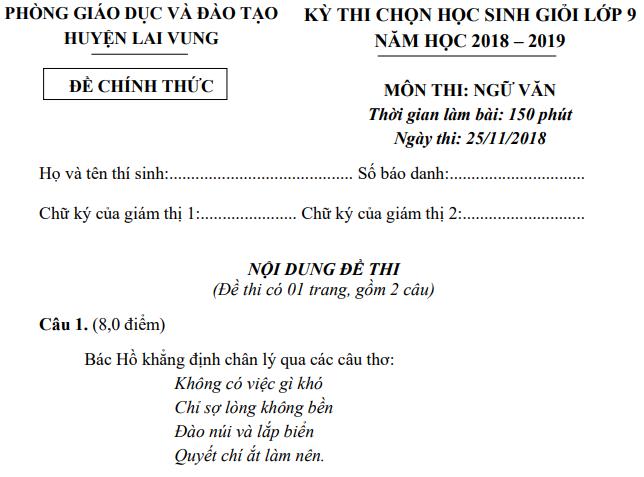
Phòng GD&ĐT huyện Lai Vung